Post
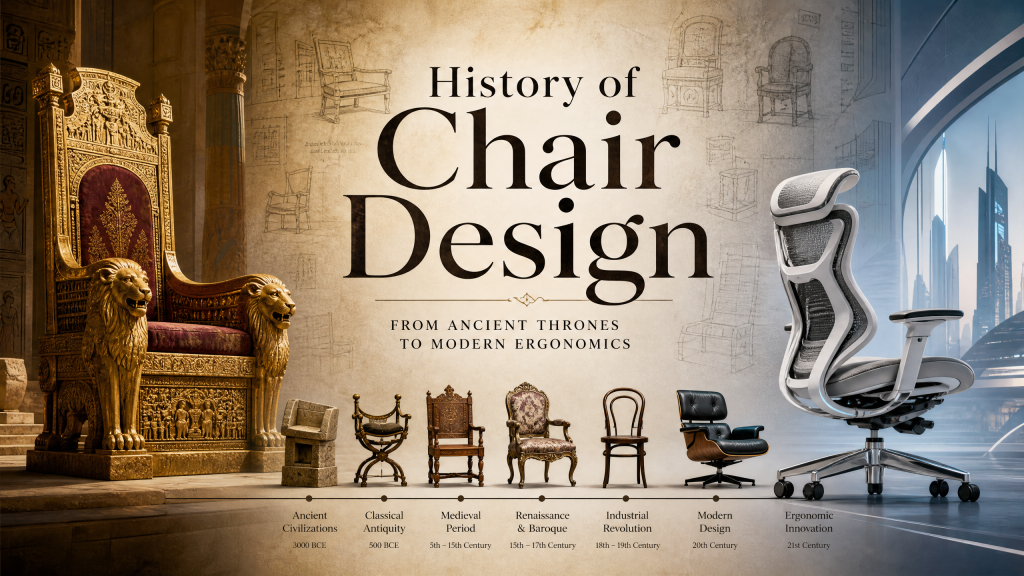
The History of Chair Design: From Ancient Thrones to Modern Ergonomics
Jun
The History of Chair Design: From Ancient Thrones to Modern Ergonomics
The chair is one of the most fundamental objects in human civilization — so fundamental that we rarely stop to think about its extraordinary history. From the ceremonial thrones of ancient Egypt to the sleek, data-driven ergonomic masterpieces of the twenty-first century, the evolution of chair design tells the story of human culture, technology, craftsmanship, and our ever-deepening understanding of the human body. This fascinating journey through history reveals how much thought, artistry, and science goes into the chairs we sit on every day, making them not just utilitarian objects but also powerful reflections of societal values and technological advancements.
Ancient Beginnings: The Chair as Symbol of Power
The earliest known chairs date back to ancient Egypt, approximately 2800 BCE. In these early civilizations, chairs were not everyday objects available to common people. They were symbols of power, authority, and status. Pharaohs and high-ranking officials sat on elaborately crafted thrones adorned with gold, precious stones, and intricate carvings. The famous throne of Tutankhamun, discovered in his tomb and now housed in the Egyptian Museum in Cairo, is covered in gold leaf and semi-precious stones and represents the pinnacle of ancient furniture craftsmanship. These early Egyptian chairs often featured animalistic forms, like lion’s paws for legs, further emphasizing their regal and divine connections.
In ancient Greece, a distinctive chair form called the klismos emerged around the fifth century BCE. The klismos featured elegantly curved legs that flared outward and a concave backrest that cradled the sitter’s back. This design was remarkably sophisticated for its time, demonstrating an early intuitive understanding of ergonomic principles. The klismos appears frequently in ancient Greek art and vase paintings, suggesting it was widely used among the upper classes. Alongside the klismos, simpler stools like the diphros were common, offering more versatile seating.
The Romans adopted and adapted many Greek and Egyptian furniture styles. The curule chair, a distinctive X-shaped folding stool, became a symbol of magisterial power, used by consuls and other high-ranking officials. Its portability and ceremonial significance made it a powerful emblem of authority throughout the Roman Empire. Another notable Roman chair was the bisellium, a wide seat for two, often reserved for honored guests or families of high status in public venues.
Medieval and Renaissance Periods: Function Meets Symbolism
During the medieval period in Europe, chairs remained largely symbols of authority. Most people sat on benches, stools, or the floor. The high-backed wooden chair — often called a throne chair even when not used by royalty — was reserved for the lord of a manor or the head of a household. Its high back served both a practical purpose, blocking drafts in cold stone buildings, and a symbolic one, suggesting power and importance. Common medieval chairs included the practical “coffer chair” which doubled as a storage chest, and the “joint stool,” a sturdy, jointed wooden stool that was a precursor to more elaborate seating.
The Renaissance brought an explosion of decorative arts and a new emphasis on comfort and luxury among the wealthy merchant and aristocratic classes. Italian and French craftsmen developed increasingly elaborate chair designs featuring carved wooden frames, padded and upholstered seats, and decorative elements drawn from classical antiquity. Examples include the Savonarola chair and the Dante chair, both distinctive X-framed folding chairs popular in Italy. The Farthingale chair, developed in the sixteenth century, was specifically designed to accommodate the wide skirts fashionable among noblewomen of the period, showcasing how fashion directly influenced chair design.
The Industrial Revolution: Chairs for Everyone
The Industrial Revolution of the eighteenth and nineteenth centuries transformed furniture manufacturing, just as it transformed every other aspect of material culture. Steam-powered machinery made it possible to produce chairs in large quantities at much lower cost than traditional hand craftsmanship. For the first time in history, chairs became genuinely affordable for ordinary working-class families, shifting from luxury items to everyday necessities.
One of the most significant developments of this era was the bentwood chair, pioneered by Austrian furniture maker Michael Thonet in the 1850s. Thonet developed a technique for steaming and bending solid wood into curved shapes, which allowed the creation of elegant, lightweight chair frames at industrial scale. The Thonet No. 14 chair, introduced in 1859, became one of the best-selling chairs in history and is still in production today in virtually unchanged form. This innovation democratized chair ownership and paved the way for mass-produced furniture.
The Modernist Movement: Form Follows Function
The early twentieth century saw the birth of modernism in design and architecture, which had a profound influence on chair design. The Bauhaus school in Germany, founded in 1919, brought together artists, craftsmen, and designers to explore the relationship between art, craft, and industrial production. Bauhaus designers like Marcel Breuer and Mies van der Rohe created iconic tubular steel chairs that embraced industrial materials and rejected decorative ornamentation in favor of pure functional form.
- Marcel Breuer’s Wassily Chair (1925): Inspired by the frame of a bicycle, this chair utilized bent tubular steel and canvas to create a lightweight, visually transparent, and mass-producible design.
- Mies van der Rohe’s Barcelona Chair (1929): Designed for the German Pavilion at the 1929 International Exposition in Barcelona, it features a sleek chrome-plated flat steel frame and leather cushions, embodying luxury and minimalist elegance.
The Eames lounge chair, designed by Charles and Ray Eames in 1956 and produced by Herman Miller, represents perhaps the perfect synthesis of modernist ideals: it is beautiful, functional, comfortable, and uses modern materials and manufacturing techniques in innovative ways. It remains one of the most recognized and coveted chair designs in history.
Mid-Century Modern and Scandinavian Design: Function, Comfort, and Elegance
Following the initial wave of modernism, the mid-20th century (roughly 1945-1965) saw an explosion of innovative chair designs, characterized by clean lines, organic forms, and new materials. Mid-Century Modern designers often prioritized comfort and accessibility while maintaining aesthetic appeal.
The work of Charles and Ray Eames, beyond their famous lounge chair, explored molded plywood and fiberglass, creating chairs like the Eames Plastic Side Chair and the Eames Molded Plywood Lounge Chair, which were revolutionary in their use of materials and mass-production potential.
Simultaneously, Scandinavian design rose to prominence, emphasizing natural materials, craftsmanship, and a deep understanding of ergonomics and human comfort. Iconic designers from this period include:
- Arne Jacobsen: Known for his highly recognizable chairs like the “Egg Chair” and “Swan Chair” (1958), which featured organic, sculptural forms and were designed to provide comfort in public spaces.
- Hans Wegner: Often called the “master of chairs,” Wegner designed over 500 chairs, famous for their elegant simplicity and robust construction. His “Wishbone Chair” (1949) and “The Chair” (1949), often celebrated for their perfect balance of form and function, became symbols of Danish modern design.
- Eero Saarinen: A Finnish-American designer, his “Tulip Chair” (1956) aimed to eliminate the “slum of legs” under tables, offering a single pedestal base for a futuristic, cohesive look.
These designers collectively shaped an era where chairs were not just functional items but pieces of art, embodying timeless style and enduring comfort.
The Ergonomic Revolution: Science Meets Design
The second half of the twentieth century brought a new scientific approach to chair design. As more people entered sedentary office jobs and researchers began studying the health effects of prolonged sitting, furniture manufacturers began collaborating with ergonomists, physiotherapists, and biomechanical engineers to create chairs that actively supported healthy posture and reduced strain. The focus shifted from mere aesthetics to user well-being and productivity.
Key features that define ergonomic chairs include:
- Adjustable Lumbar Support: Crucial for maintaining the natural curve of the spine.
- Seat Depth and Height Adjustment: To accommodate various body types and allow feet to rest flat on the floor.
- Recline and Tilt Mechanisms: Allowing users to shift posture and relieve pressure on the spine.
- Armrest Adjustments: To support the arms and shoulders, reducing strain on the neck.
- Breathable Materials: Such as mesh, to prevent heat buildup and ensure comfort during long periods of sitting.
The Herman Miller Aeron chair, introduced in 1994, is widely regarded as a landmark moment in ergonomic chair design. Its mesh construction, adjustable PostureFit lumbar support, and wide range of customization options set a new standard for what an office chair could and should do for its user’s body. It became a symbol of the dot-com era and remains a bestseller decades later, inspiring countless other ergonomic designs focused on health and user experience.
Contemporary Trends: Sustainability, Smart Technology, and Customization
Today’s chair market is extraordinarily diverse, offering everything from beautifully crafted traditional wooden chairs to technologically sophisticated ergonomic office chairs that adjust dynamically to your body’s movements. The modern era is defined by several key trends that are shaping the future of chair design:
- Sustainability: A growing emphasis on using recycled, recyclable, or sustainably sourced materials, and designing chairs for longevity or easy disassembly and recycling. Brands are innovating with materials like recycled ocean plastic, bamboo, and cork.
- Smart Technology Integration: Chairs now feature built-in sensors to monitor posture, track sitting time, provide haptic feedback, or even integrate heating/cooling elements and charging ports.
- Customization and Personalization: Beyond basic adjustments, many chairs offer extensive options for fabric, color, components, and even bespoke fitting, allowing users to create a chair perfectly suited to their individual needs and aesthetic preferences.
- Hybrid and Multi-functional Design: With the rise of remote work and smaller living spaces, chairs are often designed to be versatile, serving multiple functions or seamlessly blending into different environments, from dining rooms to home offices.
- Gaming Chairs: A rapidly growing segment, specifically engineered for long hours of gaming, offering enhanced support, adjustability, and often bold aesthetics.
Our store proudly carries chairs that honor the rich history of this essential object while embracing the innovations that make modern seating better for our bodies and our lives. Come discover the perfect chair for your home or office today.
Frequently Asked Questions About Chair Design
Here are some common questions about the history and evolution of chairs:
- Q: Why were early chairs only for royalty or the elite?
- A: In ancient civilizations, chairs were expensive to produce, requiring skilled craftsmanship and valuable materials. They were status symbols that visually distinguished rulers and high-ranking officials from common people, who typically sat on the floor, stools, or benches.
- Q: What is the significance of the Thonet No. 14 chair?
- A: The Thonet No. 14, introduced in 1859, is significant for its innovative bentwood technology that allowed for mass production. It was elegant, lightweight, durable, and affordable, making it one of the first truly democratic chair designs and a global bestseller.
- Q: How did the Bauhaus movement influence modern chair design?
- A: The Bauhaus school emphasized functionality, industrial materials (like tubular steel), and minimalist aesthetics. Its designers rejected ornamentation, believing that form should follow function, which led to streamlined, efficient, and often mass-producible chair designs that defined early modernism.
- Q: What are the main benefits of an ergonomic chair?
- A: Ergonomic chairs are designed to support the natural posture of the human body, reducing strain and discomfort during prolonged sitting. Benefits include improved posture, reduced back pain, increased comfort, and enhanced productivity by minimizing fatigue.
- Q: What is “sustainable chair design”?
- A: Sustainable chair design involves creating chairs using environmentally responsible materials (recycled, renewable, non-toxic), efficient manufacturing processes, and designing for durability, repairability, and end-of-life recycling. The goal is to minimize environmental impact throughout the chair’s lifecycle.
“`
