Post
Chairs Legs Explained: Hairpin, Tapered, Turned, and Sled — What’s the Difference?
Jun
Chair Legs Explained: Hairpin, Tapered, Turned, and Sled — What’s the Difference?
When people shop for chairs, they often focus primarily on the seat, back, and upholstery — the parts they interact with most directly. But the legs of a chairs are far more than structural elements that keep the seat off the floor. They are a significant part of the chair’s visual identity, its relationship to the ground plane, its apparent weight and solidity, and its connection to specific design traditions and historical periods. Understanding the different leg styles available will help you make more informed choices and better explain the specific aesthetic you are looking for when shopping for furniture that truly complements your interior design.
Why Chair Legs Are More Than Just Supports
Beyond their foundational role in holding up the chairs, legs play several critical roles that influence both the functionality and aesthetics of a piece of furniture. Their design impacts the overall stability, the way a chair interacts with different floor surfaces, and even its ergonomic comfort. A well-designed leg not only supports weight but also helps distribute it, preventing undue stress on joints and ensuring longevity. From a design perspective, the legs can dictate whether a chair feels grounded and substantial, or light and airy, fundamentally altering the perception of space in a room.
- Structural Integrity: The primary function, ensuring the chair can safely bear weight.
- Stability: Legs are crucial for preventing wobbling or tipping, providing a secure seating experience.
- Aesthetic Contribution: They define a chair’s style, from traditional elegance to modern minimalism.
- Floor Protection: The design and material of legs, often paired with glides or pads, prevent scratches and damage to flooring.
- Ergonomics: Leg height and angle contribute to the overall comfort and posture provided by the chair.
Tapered Legs: Clean, Modern Elegance
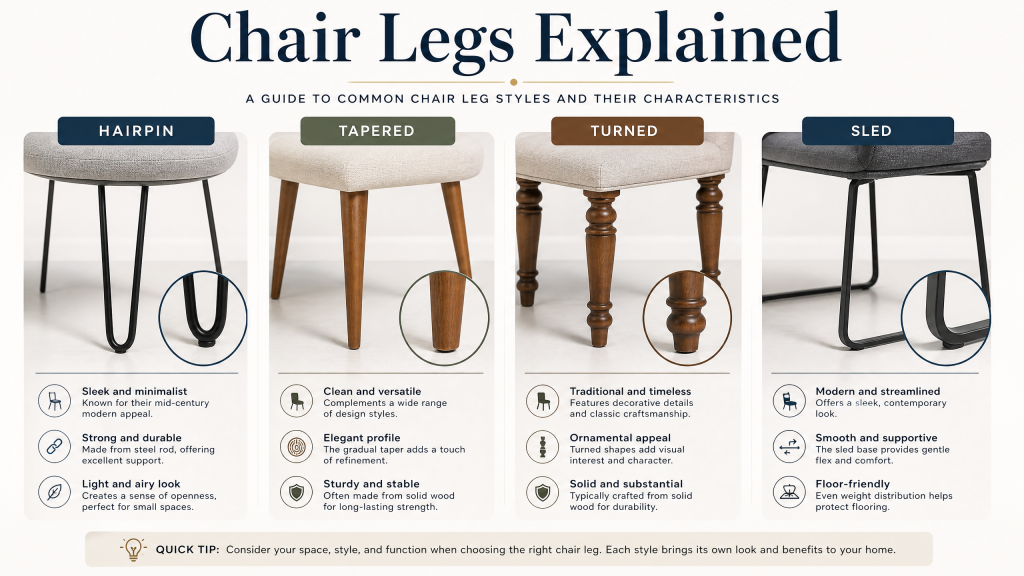
Tapered legs are perhaps the most versatile and widely used leg style in contemporary furniture design. A tapered leg is thicker at the top, where it connects to the seat frame, and narrows progressively toward the floor. This tapering creates a sense of lightness and elegance — the chair appears to become more delicate and refined as it approaches the ground.
Tapered legs are most closely associated with mid-century modern design, where they were used extensively in the 1950s and 1960s by designers like Charles and Ray Eames, Eero Saarinen, and Hans Wegner. However, the tapered leg is genuinely timeless and works well in transitional, contemporary, and even some traditional settings depending on the wood species, stain, and the overall chair silhouette. Their clean lines make them highly adaptable, allowing them to blend seamlessly into various decor styles without overwhelming other design elements.
In terms of materials, tapered legs are most commonly found in solid wood — walnut, teak, beech, and oak are all popular choices. Metal tapered legs, typically in powder-coated steel or brass, offer a more contemporary and industrial variation on the theme. The angle at which the legs are attached also varies, with some chairs having legs that angle outward from the seat frame for added stability and visual interest, known as splayed legs. This splaying further enhances their modern appeal and often contributes to a more dynamic silhouette.
- Key Characteristics: Thicker at the top, gradually narrowing towards the bottom.
- Associated Styles: Mid-century modern, contemporary, transitional.
- Common Materials: Solid wood (walnut, teak, oak), metal (steel, brass).
- Design Impact: Creates a sense of lightness, elegance, and refined simplicity.
Hairpin Legs: Industrial Minimalism
The hairpin leg, made from thin steel rod bent into a characteristic two-pronged form, became an icon of mid-century design when it was developed in the 1940s by designer Henry P. Glass during wartime material shortages. After decades of relative obscurity, hairpin legs experienced a dramatic revival in the 2010s as the industrial and mid-century modern aesthetic became dominant in contemporary interior design. Their distinctive loop and minimalist structure offer a striking contrast to more traditional leg styles.
Hairpin legs are minimalist in the extreme — they reduce the visual presence of the support structure to the minimum possible while maintaining structural integrity. This creates a striking visual effect in which the seat or tabletop appears almost to float above the floor. They work particularly well with solid wood or concrete surfaces, creating a pleasing contrast between the organic or massive quality of the seat and the linear, engineered precision of the metal legs. This material juxtaposition is a hallmark of the industrial chic look.
The practical characteristics of hairpin legs deserve mention. Because they are made from relatively thin steel rod, hairpin legs are quite rigid and strong despite their delicate appearance. They are easy to install on almost any flat surface, making them popular for furniture makers and DIY enthusiasts looking to create custom tables, desks, or benches. They are available in a range of heights and finishes, from raw steel (which offers a true industrial look) to powder-coated black, white, or colored options, allowing for customization to match various decor schemes. Many come with pre-drilled mounting plates for straightforward attachment.
- Key Characteristics: Bent steel rod, two-pronged, minimalist profile.
- Associated Styles: Industrial, mid-century modern, DIY furniture.
- Common Materials: Steel (raw, powder-coated, chrome).
- Design Impact: Creates a “floating” aesthetic, emphasizes the tabletop/seat, strong industrial appeal.
Turned Legs: Traditional Craftsmanship
Turned legs are produced on a woodworking lathe, which rotates the wood while a cutting tool shapes it into a symmetrical profile. The result is a leg with a series of curves, bulges, and tapers that are characteristic of traditional furniture styles. The specific profile of turned legs — the exact sequence of shapes along their length — varies enormously across different historical periods and regional traditions, showcasing the skill of the artisan and the prevailing design sensibilities of the time.
Turned legs are most closely associated with traditional, colonial, and country furniture styles. Queen Anne furniture features a specific turned leg with a characteristic pad foot or a distinct cabriole curve terminating in a scroll or paw. William and Mary furniture uses elaborate trumpet-turned legs, often with intricate carvings. Early American country furniture uses simple, rustic turned legs that telegraph honest, unpretentious craftsmanship, often seen in spindle-back chairs or farmhouse tables. In more contemporary interpretations, turned legs can provide an interesting contrast to otherwise modern chairs, creating a transitional aesthetic that combines historical reference with modern sensibility. Common turned patterns include baluster, reeded, fluted, and spiral.
- Key Characteristics: Symmetrical, carved profiles (balusters, reeds, flutes, spirals).
- Associated Styles: Traditional, colonial, country, Victorian, transitional.
- Common Materials: Solid wood (oak, mahogany, cherry, maple).
- Design Impact: Adds ornate detail, historical charm, and a sense of handcrafted quality.
Sled Legs: Architectural Continuity
Sled legs, also called runners or base legs, are essentially continuous curved or angled structural elements that extend from the back of the chair frame, down to the floor, forward, and up into the front leg. Rather than four separate leg elements, a sled-leg chair has two continuous base elements, one on each side. This creates a strong sense of visual continuity and architectural integrity, making the chair appear as a unified, sculptural form rather than an assembly of parts.
Sled legs are associated with modernist and Scandinavian design traditions and were used extensively by designers like Arne Jacobsen (e.g., his Series 7 chairs often feature variations) and Florence Knoll in the mid-twentieth century. They give a chair a sense of movement and dynamic energy even when it is static, suggesting forward motion or the arc of a swing. Their continuous form also offers excellent stability, especially on uneven floors or thick carpets, as the weight is distributed over a larger surface area.
While often made from bent metal tubing (chrome-plated steel being a classic choice), sled legs can also be crafted from bent plywood or solid wood, offering different aesthetic and structural qualities. The seamless design is practical too; it minimizes snagging on carpets and offers a smooth glide across hard surfaces, reducing the need for individual floor protectors on multiple points. Their sleek profile makes them ideal for contemporary dining chairs, lounge chairs, and even office seating.
- Key Characteristics: Continuous loop or runner shape, often two main bases instead of four individual legs.
- Associated Styles: Modernist, Scandinavian, contemporary office furniture.
- Common Materials: Bent metal tubing (chrome, steel), bent plywood, solid wood.
- Design Impact: Offers strong visual continuity, stability, and a sleek, dynamic look.
Straight/Block Legs: Understated Strength
The straight or block leg is perhaps the most fundamental and robust leg style. As the name suggests, these legs are simple, rectilinear forms – either perfectly straight, square, or rectangular. They are typically consistent in thickness from top to bottom, exuding a sense of unwavering strength and solidity. While they may lack the intricate details of turned legs or the delicate appearance of tapered ones, their straightforward design makes them incredibly versatile and enduring.
Block legs are common in a wide range of furniture styles, from rustic farmhouse tables and robust dining chairs to contemporary sofas and sturdy bed frames. They are often favored in mission-style furniture, Shaker designs, and industrial pieces where an emphasis on simple lines and honest construction is paramount. Their strength and clean aesthetic allow them to anchor a piece of furniture, providing a weighty, grounded presence. They are also practical, offering substantial support and being less prone to damage than more delicate leg styles.
- Key Characteristics: Simple, straight, square, or rectangular profile, consistent thickness.
- Associated Styles: Mission, Shaker, rustic, industrial, contemporary, farmhouse.
- Common Materials: Solid wood (oak, pine, maple), metal.
- Design Impact: Provides a sturdy, grounded, and understated aesthetic; emphasizes strength and durability.
Cabriole Legs: Elegant Curves from History
The cabriole leg is one of the most distinctive and historically rich chair leg styles, immediately recognizable by its elegant S-shaped curve. It typically bows outwards from the chair frame (the knee), then curves inwards (the ankle), and often terminates in a decorative foot, such as a paw, scroll, or ball-and-claw. This unique double curve is inspired by the leg of a leaping animal and adds a remarkable sense of grace and movement to furniture.
Originating in ancient Greece and China, the cabriole leg became highly fashionable in Europe during the 18th century, particularly in Queen Anne, Chippendale, and Louis XV furniture styles. It is synonymous with classical elegance and ornate craftsmanship. While predominantly found in traditional and antique furniture, modern interpretations sometimes feature a simplified cabriole curve, or it can be juxtaposed with contemporary elements to create unique transitional pieces. The material is almost always solid wood, often carved with additional motifs like acanthus leaves at the knee.
- Key Characteristics: Distinctive S-shaped curve (outward at the top, inward at the bottom), often with a decorative foot.
- Associated Styles: Queen Anne, Chippendale, Louis XV, Rococo, traditional.
- Common Materials: Solid wood (mahogany, cherry, walnut).
- Design Impact: Conveys classical elegance, sophistication, and historical grandeur.
Spider/Star Base Legs: Modern Dynamics and Functionality
Spider or star base legs are a hallmark of modern and functional furniture, particularly prevalent in office chairs, swivel chairs, and many contemporary dining or lounge chairs. This style features multiple spokes (typically three, four, or five) radiating outwards from a central column or hub, often ending in casters for mobility or fixed glides for stability. The spokes are usually sleek and angular, contributing to a dynamic and often futuristic aesthetic.
These bases are designed for optimal stability and functionality. The central column often incorporates mechanisms for height adjustment, swivel, or tilt, making them ideal for ergonomic seating. The spreading spokes distribute weight effectively, preventing tipping. Spider bases are almost exclusively made from metal (polished chrome, brushed aluminum, or powder-coated steel) for maximum strength and a clean, modern look. They are perfect for spaces requiring flexible seating arrangements or a high degree of mobility, such as home offices, commercial offices, or modern dining rooms where a light visual footprint is desired.
- Key Characteristics: Multiple spokes (3-5) radiating from a central point, often with casters or glides.
- Associated Styles: Modern, contemporary office, ergonomic, industrial chic.
- Common Materials: Metal (chrome, aluminum, steel).
- Design Impact: Offers excellent stability and mobility, conveys a sleek, high-tech, and functional aesthetic.
Choosing the Right Chair Legs for Your Space
Selecting the ideal chair leg style goes beyond mere aesthetics; it involves considering the practicalities of your space and lifestyle. The right legs can enhance comfort, improve stability, and ensure the longevity of both your furniture and your flooring. Think about how the chair will be used, the overall design scheme of the room, and the specific challenges or opportunities your space presents.
- Consider Your Floor Type:
- Hardwood/Laminate: Sled legs can glide smoothly, while individual legs need felt pads. Metal legs might scratch without protection.
- Carpet: Wider bases (sled, block) or casters on spider bases can make movement easier. Thin individual legs might sink.
- Tile: Smooth legs or those with soft glides are best to avoid chipping or scratching.
- Match Your Existing Decor:
- Modern/Minimalist: Tapered, hairpin, sled, or spider legs fit seamlessly.
- Traditional/Classic: Turned or cabriole legs complement these styles beautifully.
- Industrial/Rustic: Hairpin and block legs are excellent choices.
- Assess Room Size:
- Small Spaces: Tapered or hairpin legs offer a lighter visual footprint, making the room feel more open.
- Large Spaces: Block or more substantial turned legs can help ground larger pieces in bigger rooms.
- Intended Use:
- Dining Chairs: Stability is key (block, tapered, sled).
- Office Chairs: Mobility is paramount (spider base with casters).
- Lounge Chairs: Comfort and aesthetic appeal are balanced.
- Maintenance Requirements: Some finishes or materials require more specific care than others.
Maintaining Your Chair Legs: Tips for Longevity
Proper care for your chair legs ensures their beauty and structural integrity for years to come. Different materials require different approaches to cleaning and protection. Regular maintenance can prevent issues like scratches, rust, and weakening joints, prolonging the life of your beloved furniture.
- For Wooden Legs:
- Regular Dusting: Use a soft, dry cloth to prevent dust buildup.
- Cleaning: Wipe with a damp cloth (not wet) and mild soap if needed, then dry immediately.
- Polishing/Oiling: Apply wood polish or oil every few months to nourish the wood and maintain its luster.
- Avoid Moisture: Protect from spills and high humidity to prevent warping or swelling.
- Sunlight Protection: Position away from direct sunlight to prevent fading or drying out.
- For Metal Legs (Hairpin, Sled, Spider):
- Cleaning: Wipe with a damp cloth and mild detergent, then dry thoroughly to prevent water spots and rust.
- Rust Prevention: For raw steel or cast iron, consider applying a clear wax or sealant, especially in humid environments. Promptly address any signs of rust.
- Finish Care: For powder-coated or painted metal, avoid abrasive cleaners that can scratch the finish.
- General Tips for All Leg Types:
- Floor Protectors: Always use felt pads, rubber caps, or glides to prevent scratching floors and reduce noise. Replace them as they wear out.
- Tighten Joints: Periodically check and tighten any screws or bolts that secure the legs to the chair frame. Loose joints can lead to wobbling and eventual damage.
- Avoid Harsh Chemicals: Many cleaning products can damage finishes or materials. Always test in an inconspicuous area first.
- Lift, Don’t Drag: Always lift chairs when moving them, rather than dragging, to protect both the legs and your flooring.
Frequently Asked Questions About Chair Legs
Can I replace the legs on my existing chair?
Yes, in many cases, you can replace chair legs. This is a popular way to update furniture, change its style, or repair damage. Most chairs use standard mounting plates or screws, making replacement relatively straightforward. However, it’s crucial to ensure the new legs are compatible in terms of size, weight capacity, and mounting method with your chair’s frame. Always measure carefully and choose legs appropriate for the chair’s intended use.
How do I protect my floors from chair leg scratches?
The best way to protect your floors is by using appropriate glides or pads on the bottom of each leg. Felt pads are excellent for hardwood, laminate, and tile floors. Rubber caps or silicone sleeves can also work well, especially for metal legs, providing grip and preventing scratches. For carpet, wider glides or specialized chairs feet can prevent legs from sinking in too deeply. Regularly check and replace worn-out pads.
What leg style is best for stability?
While all well-constructed legs are designed for stability, certain styles offer inherent advantages. Block legs and sled legs typically provide excellent stability due to their solid form and wider contact points with the floor. Splayed tapered legs also enhance stability by widening the base. Spider bases on office chairs are designed for multi-directional stability. Ultimately, the quality of construction and joint integrity are as important as the leg style itself.
Are metal or wood legs more durable?
Both metal and wood legs can be incredibly durable, depending on the type of material and construction quality. High-quality solid hardwood legs (like oak or maple) are very strong and can last generations with proper care. Steel and aluminum metal legs are also highly durable, resistant to rot and pests, and can withstand significant stress. Metal can be more prone to showing scratches or dents in some finishes, while wood can be susceptible to moisture damage if not sealed. The choice often comes down to aesthetic preference and specific environmental conditions.
How do I clean different types of chair legs?
For most wooden legs, a soft, damp cloth with a mild wood cleaner is sufficient, followed by immediate drying. Avoid excessive moisture. For metal legs, a damp cloth with a little dish soap usually works well; dry thoroughly to prevent water spots and rust. Avoid abrasive cleaners on any finish. For intricate turned legs, a soft brush can help remove dust from crevices before wiping. Always test any new cleaning product in an inconspicuous area first.
Our store carries chairs in all of these leg styles, and our design team loves discussing the visual language of furniture with curious customers. Come in to explore how different leg styles can transform the character of a chairs and the room it inhabits.
